
Maintenance & Prevention
Six Things Worth Doing Once a Year in a South Florida Kitchen
Six jobs, once a year, and the right time here is spring rather than autumn — before the season that works these machines hardest rather than after it. Vacuum the condenser behind the base grille of every refrigeration appliance, which is the single highest-value ten minutes in the kitchen. Run the banknote test on every door seal. Take the dishwasher filter out, wash it, and look at the spray arm holes while it is out. Clean and descale the ice machine, which is the appliance most often left until it stops. Check that the wine cellar's grille is not covered by a kick panel or blocked by storage. And photograph all nine model plates, which costs nothing and saves an afternoon on the day something fails. None of them needs a tool beyond a vacuum, and between them they prevent a meaningful share of the calls we take.
The full guide
Jenn Air refrigerator maintenance, and why the cheap version happens first
Nearly every expensive repair on this site has an inexpensive version of itself that happened earlier and went unnoticed.
A packed condenser is a compressor working too hard, every day, for two years — and then a sealed-system repair. An ice machine nobody cleaned is a scaled water path and then a pump. A wine cellar with a covered grille is a cabinet drifting two degrees for eight months, and by the time anybody notices, the drift is not the problem any more.
The list below is not a maintenance schedule invented to sell visits. It is what we would do in our own kitchens, and every item on it is free.
It is written for a JennAir kitchen in Miami rather than for an appliance in general: the intervals below are shorter than the manuals', because salt air and eleven months of humidity are what actually decide them here.
Do It in Spring
Timing matters here in a way it does not in a temperate climate.
From May onward these appliances have their hardest months: a kitchen that is warm around the clock, an ambient temperature the condenser has to work against, ice machines asked for far more than usual, and a storm season that cycles the power.
Everything on this list is worth more done in April than in November. Get the machines right before the season, not after it.
The Six
1. Vacuum the condenser — every refrigeration appliance
The single highest-value ten minutes in the kitchen.
Take off the base grille — it comes away by hand — and vacuum the coil and the fan behind it with a brush attachment.
Do it on everything that makes cold: the refrigerator, the freezer column, the wine cellar, the undercounter ice machine. People do the big refrigerator and forget the other three, and the other three are in the tightest spaces with the least airflow.
In a coastal kitchen these fill faster than anyone expects. A condenser packed with dust does not stop the appliance; it makes the compressor work harder for the same result, permanently. That is how the most expensive component in the machine gets worn out quietly.
2. The banknote test on every door
Close the door on a banknote, half in and half out, then pull it out. It should drag.
Every eight to twelve inches, all the way round, both doors. Anywhere it slides out freely, cold air is leaving continuously and warm humid air is arriving — which in this climate shows up as condensation, frost, and a compressor that never rests.
Two minutes per appliance. There is a whole page on this site about why it is worth it.
3. Take the dishwasher filter out and wash it
It lifts out of the floor of the tub by hand, usually with a quarter turn. Wash it in hot soapy water — including inside the mesh, where the material collects that you cannot see.
While it is out, look at the spray arm holes. They block, and a blocked hole is a section of the load that is not getting washed.
Once a year is the minimum on a machine in daily use. Every few months is better, it takes two minutes, and it is the most common single reason a dishwasher stops cleaning properly.
4. Clean and descale the ice machine
The appliance most often left entirely alone until the day it stops.
Follow the manufacturer's own cleaning routine with the cleaner it specifies. In hard water — which is most of this region — scale builds in the water path and the difference between a machine cleaned annually and one never cleaned is measured in years of life.
5. Check the wine cellar can breathe
Look at the base grille and ask two questions: is it there, and is anything in front of it?
An undercounter wine cabinet takes its cooling air in and pushes warm air out through that one opening. In a kitchen finished after the appliances went in, a flush kick panel is regularly run across it by a cabinetmaker who never saw the machine run. Cases of water stored in front of it do the same job.
The cabinet will not report this. It will simply hold two degrees warmer than you asked, indefinitely.
6. Photograph all nine model plates
No tools, ten minutes, and it saves the worst part of the day something fails.
The plates are in nine different awkward places — there is a page on this site listing every one of them. Photograph each, get the serial in the same shot, and put the pictures somewhere you will find them in two years.
Every conversation about a built-in appliance starts with that number, and the moment you need it is the moment you least want to be lying on the floor with a torch.
What This Does Not Include
Deliberately, because the frequency is wrong for an annual list:
The hood or downdraft grease filter — monthly. In a kitchen that cooks properly, a filter wants washing far more often than once a year. On a downdraft it is the first of the five things that stop one pulling air.
The dishwasher filter, arguably. Annual is the minimum, not the ideal.
Anything behind a panel. Nothing on this list involves opening an appliance, removing a fixed cover, or reaching anything electrical. If a job needs that, it is not owner maintenance and it is not on this page.
What It Prevents
Being specific, because "maintenance is good" is not an argument:
| Ten minutes | Prevents |
|---|---|
| Vacuuming a condenser | A compressor running at high duty for years |
| The banknote test | A cabinet that cannot hold temperature, and the frost that comes with it |
| Washing a dishwasher filter | Poor cleaning, smells, and a blocked drain path |
| Descaling an ice machine | A scaled water path and, eventually, a pump |
| Clearing a cellar grille | Six months of drift nobody notices until the wine is opened |
| Photographing the plates | An afternoon, on the worst possible day |
None of it is difficult. All of it is easier than the call it prevents.
None of it is unique to JennAir either. It is worth more here than elsewhere for one reason only: the coast is what shortens the intervals, and the intervals are what decide the bills.
If it turns out to be a repair
What this leads to, and what it costs
Every job on this site is priced the same way: an on-site diagnostic first, the figure agreed in writing before anybody starts.
-

from $175 Appliance maintenance
One visit covering every filter, condenser, seal, grille, duct and descale in the kitchen. This row exists to keep the $695 row away, and in a house with a full suite from one maker it is the cheapest money on this site.
- Every appliance in the kitchen on one visit
- Second and third appliance far cheaper than the first
- Written down, so next year starts from a record
-

Built-in · Column · French door · Undercounter · Drawers · Beverage centers · 18"–48" Refrigerators
The largest row in this line and the one this phone rings about most. Built-in cabinets and panel-ready columns from 18 to 48 inches, French door, the undercounter units that live in an island or a bar run, refrigerated drawers and beverage centers. Most of them are trimmed into your cabinetry, which is the first thing we need to know.
- The refrigerator drifting warm while the freezer holds
- Water on the floor, or ice building where it should not
- A cabinet running constantly and never quite getting there

Questions people ask about this
Why spring rather than the end of the year?
Because the point is to have the machines in good order before the months that work them hardest, not to tidy up afterwards. From May onward a condenser in a warm kitchen is running against a much higher ambient temperature, an ice machine is being asked for far more ice, and the power is cycling with the storms. Everything on this list is worth more done in April than in November.
Is the condenser really the most important one?
Yes, and it is not close. A condenser packed with dust makes the compressor work harder for the same result, every hour of every day, for years. It shortens the life of the most expensive component in the appliance and it is prevented by ten minutes with a vacuum. If you only ever do one thing on this list, do that one — on every refrigeration appliance in the kitchen, not just the big one.
How do I know if a dishwasher filter needs doing?
Take it out and look. If glassware has started coming out gritty or with a film, or the machine smells between cycles, it is overdue. On a machine in daily use, once a year is the minimum and every few months is better — it takes two minutes and it is the most common single cause of a dishwasher that is not cleaning properly.
Do I need to descale anything else?
In hard water, the ice machine matters most because scale attacks the water path and the pump. Steam ovens where fitted have their own descale routine and will usually tell you when they want it. Everything else in the kitchen is less sensitive, although a dishwasher in hard water benefits from a cleaning cycle now and then.
What about the range hood or downdraft filter?
Monthly rather than annually if the kitchen cooks properly, which is why it is not on this list — an annual reminder is the wrong frequency for it. A saturated grease filter moves air and removes nothing, and on a downdraft it is the first of the five things that stop one working.
Is any of this going to void my warranty?
No. Everything here is owner maintenance described in the manuals: vacuuming a condenser, washing a filter, running a cleaning cycle, checking a seal. Nothing on this list involves opening an appliance or removing a panel that is not designed to come off by hand.
Maintenance & Prevention
More guides like this one
-
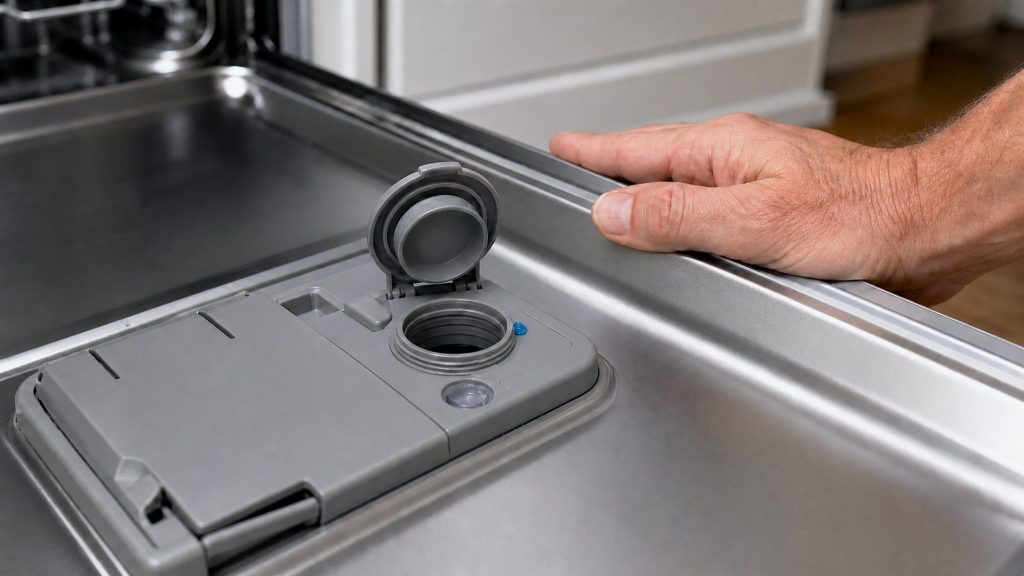
Running It Empty With Vinegar Will Not Fix the Smell. Here Is What Does
Every remedy people try fails for the same reason: the two places holding the smell are the two places the wash arms cannot reach.
Read more -

Nine Appliances, Nine Places the Plate Hides
On a built-in kitchen nothing has a visible back, and half of these plates need a phone held into a cabinet at an angle you cannot see. Here is where each one is, and why a photograph beats writing it down.
Read more -

A Two-Minute Test That Can Save You a $695 Repair
A tired door seal produces every symptom of a failed sealed system — a cabinet that will not hold temperature, condensation, frost where there should be none, a compressor that never stops. It costs a fraction as much to fix, and a banknote finds it in two minutes.
Read more
Tell us the model number and what it is doing.
This article is based on:
- Official manufacturer documentation
- Internal repair procedures
- Technician repair history
- Company quality standards